
Okay, here's what really makes a job fulfilling
I screened 45 studies to find out


If you’re anything like me, you’ve been lied to about what makes a career fulfilling.
“Follow your passion.” “Find your purpose.” “Do what you love and you’ll never work a day in your life.”
It sounds nice. It’s also mostly wrong.
I used to think the dream job equation was simple: find what excites you, pursue it relentlessly, and satisfaction will follow. But when you actually look at the research, three decades of it across positive psychology, motivation science, and job satisfaction, the picture is completely different.
Most career advice is written by people who either got lucky or are trying to sell you something. They tell you to journal about your passions, visualize your ideal day, and trust that the universe will align.
The universe doesn’t care about your vision board.
What actually predicts whether you’ll be fulfilled in your work is far more concrete, far more actionable, and far less romantic than the self-help industry wants you to believe.
This letter is comprehensive.
It’s not a quick dopamine hit of motivation that evaporates by tomorrow. This is the kind of thing you’ll want to bookmark, reference when making career decisions, and actually think about.
We’re going to dismantle the two biggest myths about fulfilling work, rebuild from first principles using actual evidence, and give you a framework you can apply immediately.
Let’s begin.
I – Money Will Not Save You
People say money can’t buy happiness, then spend their entire careers optimizing for compensation.
Which is it?
The research is clear, and it’s not what either side wants to hear.
Money does make you happier. But the effect is pathetically small compared to what most people sacrifice to get it.
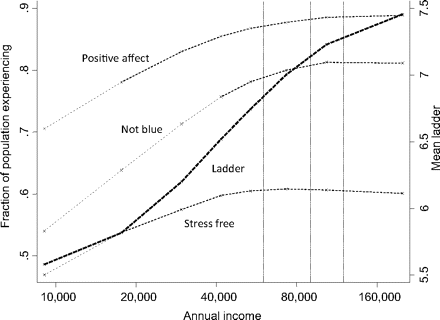
A landmark 2010 study by Kahneman and Deaton surveyed thousands of Americans. The findings: going from $40,000 to $80,000 in household income only moved life satisfaction from about 6.5 to 7 out of 10.
That’s doubling your income for half a point.
But here’s where it gets interesting. When they measured day-to-day emotional experience - whether people actually felt happy, calm, or unstressed - the line went flat around $50,000. Beyond $90,000, income had zero relationship with how people felt on a daily basis.
Now, more recent research suggests happiness might continue increasing slightly past these thresholds. Kahneman himself revisited the data in 2023 and noticed ceiling effects that may have artificially flattened the curve.
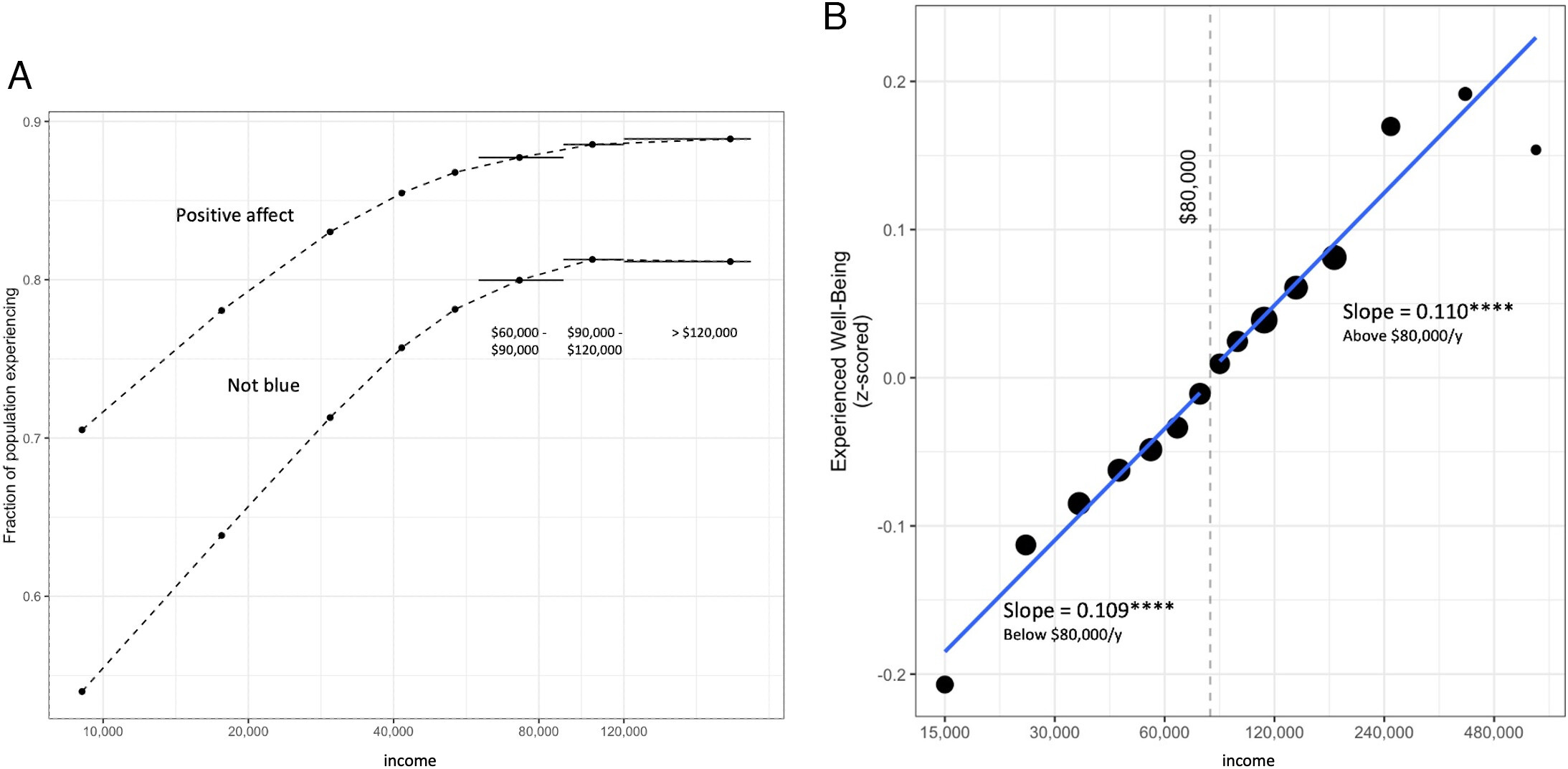
But even the most generous interpretation of the evidence leads to the same conclusion: beyond a moderate income that covers your needs and provides some security, chasing money is one of the least efficient ways to increase your life satisfaction.
You already know people who prove this. The miserable investment banker. The unfulfilled corporate lawyer. The person who “made it” financially and still feels empty.
They’re not anomalies. They’re the predictable outcome of optimizing for the wrong variable.
Adjust for your situation: if you’re single with no dependents in a moderate cost-of-living area, you’re looking at roughly $80,000 (2026 dollars) as the threshold where additional income stops moving the needle much. Add for dependents, expensive cities, and retirement savings as needed.
If you’re a college graduate in a developed country, you’ll likely land well into this range over your career anyway. Which means the marginal return on sacrificing other things for higher pay is close to zero.
The lesson isn’t that money is irrelevant. It’s that once your basic needs are met, almost everything else matters more.
II – You Don’t Actually Want A Low-Stress Job
“I just want something that’s not too stressful.”
I hear this constantly. And I get it. Burnout is real. Chronic stress destroys health and relationships.
But here’s what the research actually shows: the relationship between stress and wellbeing is not linear. It’s not “less stress = more happiness.”
It’s a curve.
Studies of high-ranking government and military leaders — people managing enormous responsibilities with less sleep and more demands — found they had lower stress hormones and less anxiety than their subordinates.
Why? Control.
When you have agency over how you work, when you set your own priorities and decide how to tackle challenges, demanding work becomes energizing rather than depleting.
The distinction isn’t between stressful and non-stressful jobs. It’s between:
Challenges that match your abilities vs. demands that exceed or underwhelm them
Short-term intensity vs. chronic, unrelenting pressure
High autonomy vs. low control
Strong social support vs. isolation
Viewing stress as useful vs. viewing it as purely harmful
A job with no challenge is boring. Boredom is its own form of suffering. A job with demands that exceed your abilities without support is crushing. But a job with meaningful challenges, autonomy, and the right context? That’s where you find flow.
The optimal state of inner experience is one in which there is order in consciousness. This happens when psychic energy—or attention—is invested in realistic goals, and when skills match the opportunities for action.
– Mihaly Csikszentmihalyi
A good book (and TED talk with over 10 million views) by psychologist Kelly McGonigal claims that stress itself isn’t the problem. It’s your belief about stress that determines whether it harms you.
She cites a study that tracked 30,000 adults over eight years. People who experienced high stress and believed stress was harmful had a 43% increased risk of dying. But people who experienced high stress but didn’t view it as harmful had the lowest risk of death in the study, even lower than people who reported relatively little stress.
Read that again.
The belief that stress is killing you might actually be what’s killing you.
McGonigal’s argument is that when you reframe stress, when you see your pounding heart as your body rising to meet a challenge rather than evidence that you’re falling apart, your physiology literally changes. Your blood vessels stay relaxed instead of constricting. Your body produces oxytocin, making you more social and more likely to seek support.
This isn’t woo-woo. It’s measurable in a lab.
The implication is uncomfortable for people who’ve built their entire worldview around stress avoidance. Maybe the goal was never to eliminate stress. Maybe it was to stop fearing it.
III – The Six Ingredients (That Actually Matter)
Forget salary brackets and prestige rankings.
When researchers actually study what makes people satisfied with their work, not what they think will make them satisfied, but what actually correlates with fulfillment, six factors emerge consistently.
1. Engaging work
What you do hour by hour matters more than your title, company, or industry.
Engaging work draws you in, holds your attention, and creates flow states. It’s why an hour of spreadsheet editing feels like torture while an hour of a well-designed game feels like minutes.
Four factors predict engagement:
Freedom to decide how you perform your work
Clear tasks with defined beginnings and ends
Variety in what you do
Feedback so you know how you’re doing
Each correlates strongly with job satisfaction (r=0.4 in meta-analyses). These aren’t soft suggestions. They’re the most empirically verified predictors we have.
2. Work that helps others
Here’s a pattern that should disturb you:
Revenue analysts, fashion designers, and TV newscast directors all have engaging work by the criteria above. Yet over 75% of people in these roles say their work isn’t meaningful.
Fire service officers, nurses, and neurosurgeons? Almost everyone finds them meaningful.
The difference is obvious: the second group directly helps people.
The evidence is robust. People who volunteer are less depressed and healthier. A meta-analysis of 23 randomized studies showed performing acts of kindness makes the giver happier. Global surveys find people who donate to charity are as satisfied with their lives as those who earn twice as much.
Helping others isn’t the only path to meaning, but it’s one of the most reliable.
3. Work you’re good at
Competence creates a sense of achievement — one of the core ingredients of life satisfaction identified by positive psychology.
But there’s a more practical reason: skill gives you leverage. If you’re good at something others value, you can negotiate for everything else; meaningful projects, engaging tasks, fair compensation, better conditions.
Even if you love art, if you pursue it without developing real skill, you’ll end up doing boring graphic design for companies you don’t care about.
Passion without competence is a trap.
4. Supportive colleagues
You don’t need to be friends with everyone at work. But you need people who will help you when you’re stuck.
“Social support” is among the strongest predictors of job satisfaction in major meta-analyses (r=0.56). Whether you can get assistance, feedback, and collaboration matters more than whether you’d grab launch with your coworkers.
Interestingly, people who disagree with you but care about your success — what Adam Grant calls “disagreeable givers” — often provide the most valuable input. They’ll tell you what others won’t.
5. Absence of major negatives
This sounds obvious, but people consistently underweight it:
Commutes over an hour (especially by bus)
Excessive hours
Pay that feels unfair
Job insecurity
The negative impact of a brutal commute can outweigh multiple positive factors. People take jobs they’re excited about, then spend two hours a day in traffic and wonder why they’re miserable.
Don’t ignore the basics.
6. Fit with the rest of your life
You don’t have to get everything from your career.
Einstein had his most productive year in 1905 while working as a patent clerk. Plenty of people find meaning through side projects, volunteering, relationships, or philanthropy while maintaining a job that simply pays the bills.
Consider how your work integrates with everything else you value.
IV – Why “Follow Your Passion” Fails
This phrase has become gospel.
Google Ngram shows its usage exploding over the past few decades. Every commencement speech, every influencer, every well-meaning parent repeats it.
And it’s not completely wrong. Intrinsically motivating work does make people happier than a big paycheck. We covered that.
But “follow your passion” fails in three specific ways.
First, it implies passion is sufficient.
Even if you love basketball, a job in basketball where you hate your colleagues, receive unfair pay, and find the work meaningless will still make you miserable. Passion doesn’t override the six ingredients. If anything, pursuing your passion into competitive fields makes satisfying those ingredients harder because everyone else is competing for the same limited positions.
Second, it alienates people who don’t have an obvious passion.
Most people don’t feel a burning calling toward a specific career. Telling them to “follow their passion” just makes them feel broken. If you don’t have a clear passion, you’re not defective. You can develop one.
Third, it encourages premature narrowing.
If you love literature, you might assume you need to become a writer and ignore dozens of other paths that could be equally fulfilling. People eliminate options that don’t immediately spark joy, not realizing that passion often develops after competence, not before.
Steve Jobs is constantly cited as the poster child for “do what you love.” But Jobs was passionate about Zen Buddhism, calligraphy, and Western history before he got into technology. He entered tech to make quick cash. His passion grew alongside his success.
The important thing for you to remember is that it does not matter in the least how you got the idea or where it came from.
– Maxwell Maltz
Your interests change more than you expect. Think about what obsessed you five years ago. It’s probably different from what interests you now. And as we established, humans are notoriously bad at predicting what will actually make them happy.
You have far more options for a fulfilling career than “follow your passion” suggests.
V – The Actual Answer
Rather than “follow your passion,” the formula that actually works is simpler and less romantic:
Get good at something that helps others.
That’s it.
If you develop rare and valuable skills in a domain that genuinely benefits people, everything else follows. You’ll have leverage to negotiate for engaging work, supportive colleagues, reasonable conditions, and fair pay. You’ll have meaning because your work matters. And you’ll develop passion because competence and contribution are intrinsically rewarding.
Adam Grant’s work in Give and Take shows that people with a “giving mindset” end up among the most successful because they attract more help and are fueled by purpose. The caveat is that pure givers who don’t protect their own wellbeing burn out. You need the other ingredients too.
People who orient their career around contribution become more motivated, more resilient, and more fulfilled than those who chase passion, status, or money.
They develop passion as a consequence of doing work that matters and doing it well. The passion comes second, not first.
VI – The Protocol
Everything above is useless if you don’t apply it.
Here’s how to actually use these ideas to evaluate your options and guide your decisions.
Exercise 1: Compare your current options
Pick two career paths you’re considering. Score each from 1-5 on:
Engaging work (autonomy, variety, clarity, feedback)
Helps others
Potential to become skilled
Quality of colleagues / social support
Absence of major negatives
Fit with your life outside work
Don’t expect any option to win on every dimension. Look for the best overall balance.
Exercise 2: Mine your past for signal
Your memory isn’t perfect, but ignoring your experience entirely is foolish. Answer these:
When have you felt most fulfilled in the past? What did those experiences have in common?
If you found out you had 10 years to live, what would you spend your time doing?
What kinds of people do you work best with?
What specific conditions (environment, pace, structure) make you thrive vs. drain you?
Exercise 3: Build your personal criteria
Combine the six research-backed ingredients with your own insights from Exercise 2.
Write down 4-8 factors that matter most to you in a fulfilling career. These become your decision criteria going forward.
When evaluating any opportunity, run it against this list. Not to find perfection, that doesn’t exist, but to find the best available option on balance.
Exercise 4: Identify your contribution path
Ask yourself:
What problems in the world do I actually care about?
What skills could I develop that would be valuable in addressing those problems?
What’s the overlap between problems I care about and skills I could realistically build?
The intersection is your highest-leverage path.
The dream job isn’t found by looking inward for some hidden passion waiting to be discovered. It’s built by developing competence in work that genuinely matters, then structuring the rest; the environment, the people, the conditions.. to support that.
Get good at something that helps others.
Everything else is a footnote.
- Abi
Excuse me while I go quit my job…
Great article thank you!